Note bene: I’ve been going through the Grimm’s 1812 volume of fairytales, one after the other for a few years. I’ll finish eventually, I promise.
[CW: vague mention of child death]
Aarne-Thompson-Uther Index type 332: Godfather Death
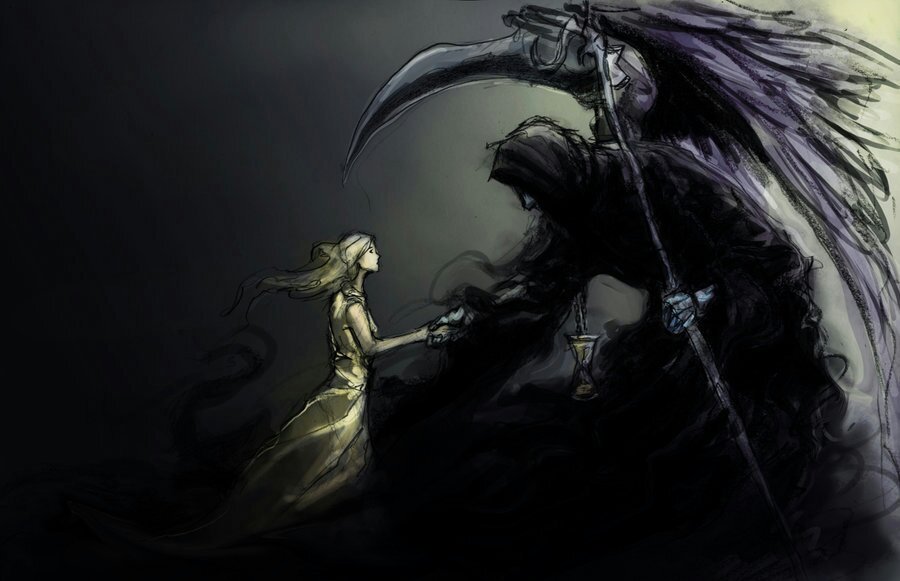
Alrighty, y’all, as you can see from the title, we’ve got a two-fer-one deal today. We’ve had these before but this is a little different. Instead of two stories under the same section, the Grimm Brothers made them two distinct stories–numbers 42 and 44 respectively–and tucked a story about sausage-on-sausage violence in-between them (yes, I am going to leave that hanging for now). However, it makes more sense to bundle them up and do them in one post, right?
Our first story, number 42, is The Godfather:
A poor man had so many children that he had already asked everyone in the world to be godfather after he had yet another child. So there was nobody left to ask. He became so distressed that he lay down and fell asleep. Then he dreamt that he was to go outside the town gate and ask the first person he met to be godfather. So that’s what the man did. He went out in front of the gate and asked the first man he met to be godfather. The stranger gave him a little bottle of water and said: “With this water you can cure the sick when Death stands at the sick person’s head, but when Death stands at the sick person’s feet, the patient must die.”
The other version, number 44 is Godfather Death:
Once upon a time there was a poor man who already had twelve children when the thirteenth was born. Since he was at his wits’ end and in such distress, he ran into the forest, where he encountered our dear Lord, who said to him: “I feel sorry for you, my poor man. I shall stand sponsor to your child at the baptism and take care of him so that he’ll live happily on this earth.” Upon saying this, the Lord left him standing there and moved on. Soon thereafter the poor man encountered Death, who likewise spoke to him and said, “I want to be your godfather and stand sponsor to your child. If he has me as his friend, he will never be in need. I’ll make him into a doctor.”
So, a man with entirely too many children runs out of people to ask to stand as godfather. That’s weird, right? Except maybe not, once I started thinking about it. I mean, if we’re assuming that these stories arose out of medieval urban legends and folklore, then it stands to reason that the people telling them, and involved in them, probably came from pretty small towns and villages. And this was at a time when the very limited options for birth control were not in the least reliable so families could be large and could find themselves in need of someone who would be willing to stand up for their children if the worst should happen. Which is how we end up with these “beggars can’t be chooser” scenarios.

The two versions of this story have some pretty wide variations in execution and ending but the gist is that the godson eventually becomes a doctor who has Death doing ride-alongs when he visits patients. If Death is standing at the patient’s head, then they will live. If he is standing at the patient’s feet, they will die.
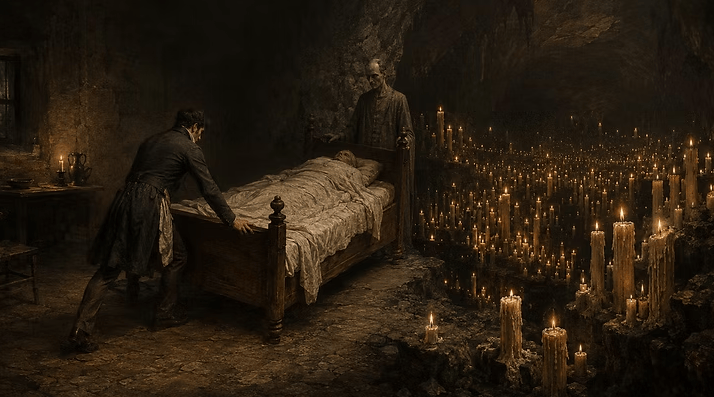
As I’m sure we can all guess would happen, the godson went along with this arrangement until a princess was on the line, and then all bets were off.
Soon thereafter the king’s beautiful daughter became sick, and nobody in the world could help her. The king wept day and night. Finally, he announced that whoever cured her would have her as his reward and marry her. So the doctor came and saw Death standing at the feet of the princess. Since he was completely enchanted by her beauty, however, he forgot all of Death’s warnings, turned the princess around, let her smell the vapors of the bottle, and rubbed the soles of her feet with the salve.
The princess was saved, but Death was, of course, not happy about this sudden turn of events.
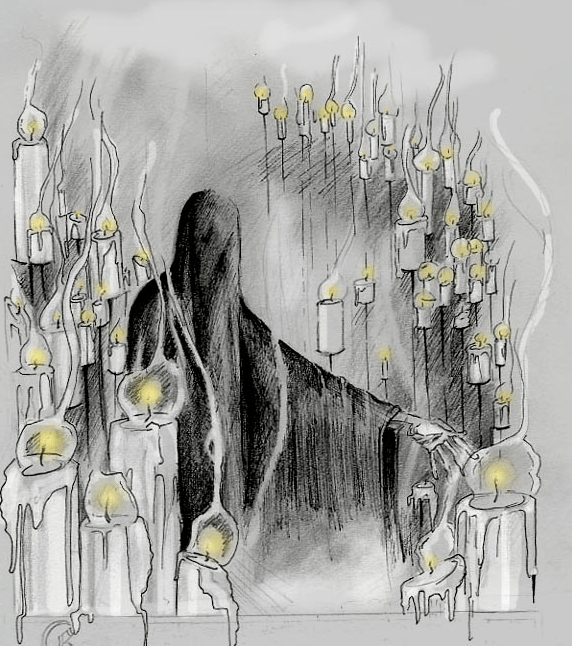
“Take a look!” Death said. “These are the candles of the living, and this light over here that’s only burning a little, this is your life. Watch out!”
Neither version of the story really has a satisfying ending, which I think we’ve come to expect from a Grimm tale, right? And, while I’m usually one to deconstruct the hell out of these stories, this is one of the times when I’m at a bit of a loss. I mean, this does seem to have the usual hallmarks of a dude going off script and doing what he wants and not really getting in trouble for it, which we’ve seen a lot. But that’s only in the second version, Godfather Death.
In the first version, the godfather and Death are two separate beings, and so, after an incident where a king’s child must die, because Death said so, the godson went to his godfather to tell him about the incident. However, as he made his way up through the floors of the house, he encountered a shovel and broom fighting, some dead fingers laying around, a pile of talking skulls, talking fish frying in a pan, and then…
…when I came to the fifth landing, I looked through the keyhole and saw that you had long, long horns.”
“Now, that’s just not true.”
And that’s where it ends. The inference, I assume, is that the godfather was actually the Devil the whole time, and this sort-of makes sense. There are some other variations out there that include the father meeting the Devil on the road while seeking out a godfather. Of course, as we should know by now, these aren’t always going to make sense to us. We are so far removed from the applicable time and place that there nuances we may never understand.
But honestly, dead fingers, a pile of talking skulls, and fish chatting while frying in a pan…? That’s a whole LOT of nuance that we’re obviously missing.

Works Cited:
Ashliman, D.L. “Godfather Death.” Godfather Death: Folktales of Type 332, 1 May 2022, sites.pitt.edu/~dash/type0332.html.
“Godfather Death.” Wikipedia, Wikimedia Foundation, 29 Jan. 2026, en.wikipedia.org/wiki/Godfather_Death.
Nugent, Elizabeth. “Turning the Bed: Godfather Death and the Costs We Refuse to See.” Dr Libby Nugent – Group Analysis, 13 Aug. 2026, http://www.libbynugent.com/post/turning-the-bed-godfather-death-and-the-costs-we-refuse-to-see.


