Harvest’s Last Sheaf
Picture it: the end of harvest season, the fields are cleared, the crops have been stored away, and all is well on the farm. And yet, despite all of this, there is one nagging bit of anxiety that can’t be dismissed… who is going to get stuck holding the Old Woman all winter?

Across a huge stretch of pre-modern Europe, people believed the grain itself had a spirit living in it. This was fine while the field was still standing; the problem was the harvest. If you cut the whole crop down, that spirit is suddenly homeless, and nobody wants a displaced grain-spirit haunting their barn through the winter. So the solution in Germany, Scotland, Cornwall, and Wales (more or less everywhere cereal grew) was to give it somewhere to live: the very last sheaf cut from the field.
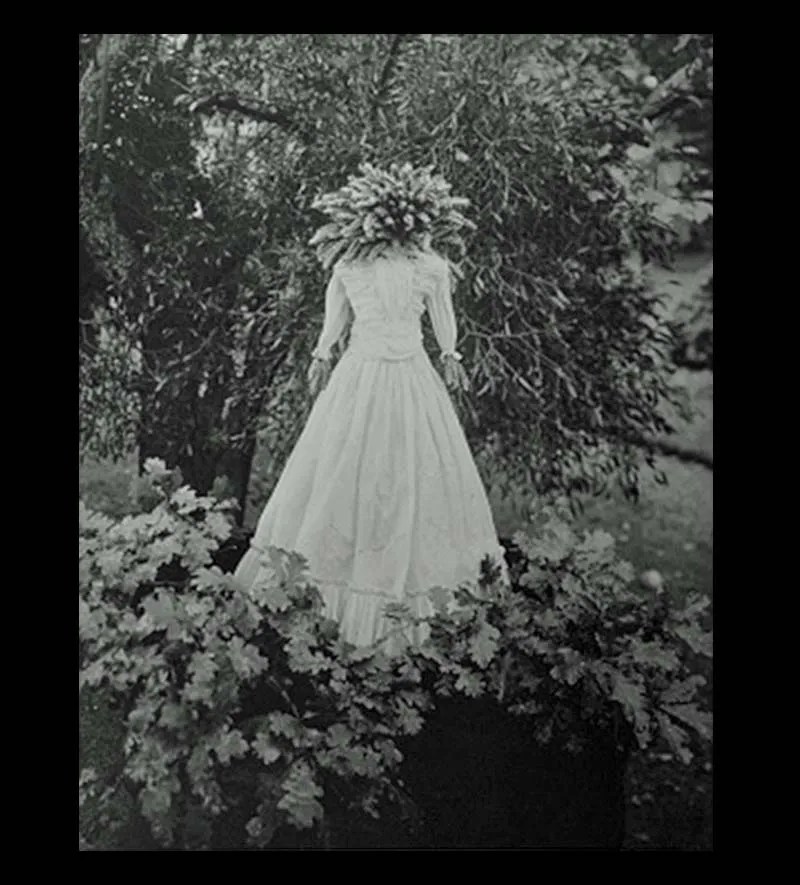
The 19th-century folklorist Wilhelm Mannhardt collected dozens of versions of this, and James Frazer ran with them in The Golden Bough. Near Danzig, the person who cut the final ears twisted them into a doll called the Corn-mother, who then rode home in state on the last wagon of the harvest. In Holstein they dressed her in women’s clothes and literally doused her with water. This was, presumably, a rain charm for next year’s crop, though I like to imagine it was also just “she’s had a long summer, she’s earned a bath.” In parts of Styria, the oldest married woman in the village had the honor of shaping her, and the finest ears went into a wreath for the prettiest girl to deliver to the local squire. So, a nice bit of harvest pageantry, grain-spirit optional.
Now, she went by a lot of names, depending on where you stood: the Carlin or Carline in Scotland, the Kirn Dolly in Roxburghshire, the Kirn Baby in the Lothians, the Neck in Cornwall and Devon, the Hare in Galloway, the Straw Dog in Shetland and Orkney, and Y Wrach in Wales. But the name I actually want to talk about is the Scottish Gaelic one: Cailleach, the Old Woman, the Hag.

If that name is ringing a bell, it should. The Cailleach is also, in wider Gaelic tradition, the hag-goddess of winter itself. She is the one who strides the hills with a staff that freezes the ground and who fights a battle with spring every year, only to lose each time, right on schedule. There’s something wonderfully on-the-nose about using her name, then, for the sheaf that gets cut last, right at the hinge between the growing year and the dead one. You’re not just making a doll; you’re naming the thing that’s about to take over.
And this is where the harvest custom gets genuinely competitive. In both Scotland and Ireland, whichever farm finished its grain harvest first got to make the Cailleach doll out of their last sheaf and then huck her into the field of a neighbor who hadn’t finished yet. And whoever was slowest to bring in their crop was stuck keeping her. They had to house her, by most accounts, through the whole winter, until she went back into the ground with spring planting. Absolutely nobody wanted to be last because nobody wanted to be stuck boarding the literal personification of winter in their barn for four months. It’s basically a very agrarian version of “hot potato,” except the potato is a dread hag-goddess and losing means bad luck for your whole household.

The specific Scottish Gaelic term for the last sheaf, by the way, was sguab mu dheireadh, and the dolly made from it could also be called the maighdean-bhuana — the harvest maiden. This often depended on the region and also, apparently on how the community was feeling about her that year. Sometimes she was an old woman and sometimes a maiden.
Once made, she’d typically be kept somewhere in the house over winter and then either fed to the livestock come spring or ploughed back into the first furrow of the new planting, returning the spirit to the field she came from, which is a nicer ending than its “fight over who has to adopt the goddess of winter,” beginning, but slightly less fun to imagine.
But there’s something steadying about the old logic here in that the end of the growing season doesn’t have to be just an ending. You can make something out of the last of it. You can give the thing you’re afraid of a name and a shape and a place to sit until spring. And if you can foist her off on your neighbor, well, that’s just a good harvest strategy.

Sources:


