Remembering in Fire and Light
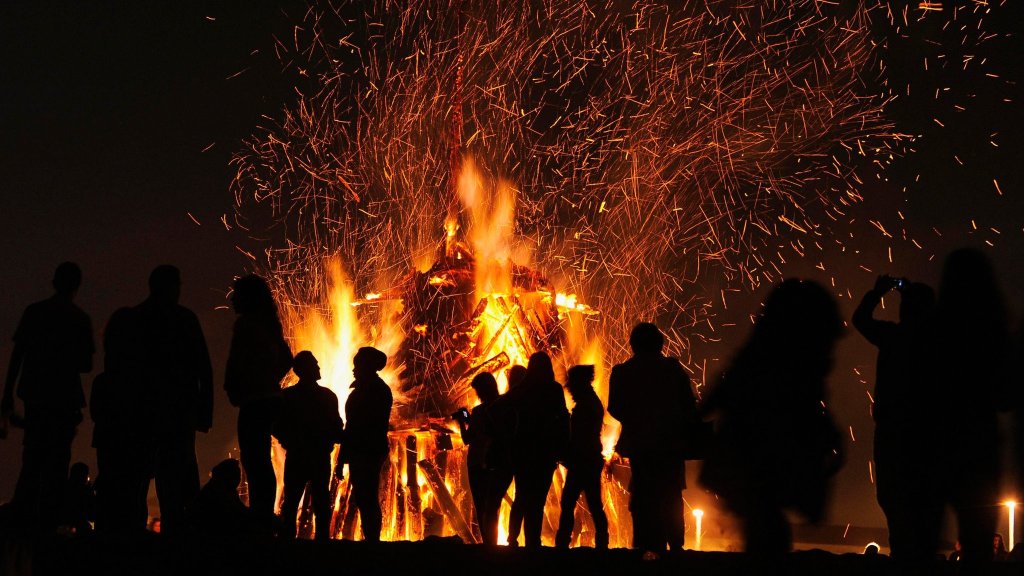
This week there are two fire festivals taking place at almost the same time in different parts of the world and their meanings could not be further apart, but both are worth a conversation. Día de los Muertos takes place on November 1st and 2nd, and three days later, on November 5th, Britain lights bonfires for Guy Fawkes Night. In each case, the same tool–fire, held up against the dark–is doing two completely opposite jobs.
Día de los Muertos falls inside the older Christian Allhallowtide window, and its best-known image is the ofrenda, a home altar built with photos, favorite foods, candles, and heaps of bright orange marigolds. The marigolds aren’t just there for decoration, either. Their scent and color are believed to guide the souls of the dead from the cemetery back to their families with the candlelight marking their path home.

Where that tradition actually comes from is more contested than the marigold-and-sugar-skull version lets on. Some scholars, following Octavio Paz, trace a real continuity back to Aztec festivals for the dead. The Mexica calendar had two twenty-day months devoted to them, including offerings left at warriors’ graves. Others, notably historian Elsa Malvido, argue that the “ancient Indigenous holiday” framing is a much later, politically motivated invention. She’s called it a “Cardenist invention,” tied to 20th-century Mexican nationalism building a usable past.
The honest answer seems to be the syncretic one sitting in the middle: real Indigenous mourning practices, compressed and reshaped under Spanish Catholic Allhallowtide, then reframed again in the 20th century to foreground their Indigenous roots. UNESCO recognized it as Intangible Cultural Heritage in 2008, which is its own kind of modern layer on top of all the others.
As for Guy Fawkes Night, I’m sure we all know the rhyme, “Remember, remember, the 5th of November, Gunpowder, treason and plot…” But what actually happened? Well, on November 5th, 1605, a man named Guy Fawkes was caught guarding thirty-six barrels of gunpowder that were stashed beneath the House of Lords. Now, why were thirty-six barrels of gunpowder beneath the House of Lord, you might ask, and I will tell you.
It was all a part of a Catholic plot to assassinate the Protestant King James I and blow up Parliament along with him, but you probably saw that coming, right? There can’t be any GOOD reason to have that much gunpowder under a government building.
Anyway, the plot failed, the king survived, and people were encouraged to light bonfires in celebration that same night. Within months, Parliament had formally set the date aside for an annual thanksgiving but the earliest recorded burning of a Pope-and-devil figure didn’t happen until 1625. The tradition hardened over the next century into something closer to open anti-Catholic theater, eventually spreading to Britain’s colonies as “Pope Day.”

I do need to add that historians David Cressy and Ronald Hutton have both specifically shut down the idea that Guy Fawkes Night is a dressed-up pagan fire festival secretly descended from Samhain or old Celtic bonfire customs. It isn’t, y’all. It’s a purpose-built, thoroughly documented piece of 17th-century political memory, a fire lit specifically to make sure nobody forgot who the enemy was supposed to be.
So we have two bonfire-adjacent traditions, a few days apart, doing almost mirror-image work. One is a fire of invitation, lit to walk a remembered loved one home and one is a fire of exclusion, lit to keep a remembered enemy burning in effigy forever. Where Guy Fawkes fire says remember so you keep this out, the Día de los Muertos ofrenda says remember so you let this back in.
This is something worth sitting with, the next time you’re warming your hands at either kind. Be safe out there.

Sources


