Samhain and the Restless Dead…
Every October, you’ll see some version of the same sentence: “the veil between the worlds grows thin at Samhain.” It shows up on altar cards, in Halloween marketing copy, and in every third Instagram caption. I’ve used it myself, entirely too often. So I went looking to see if I could find out where it actually comes from, and while the answer that I found was not at all tidy, it was way more interesting than what I was expecting.

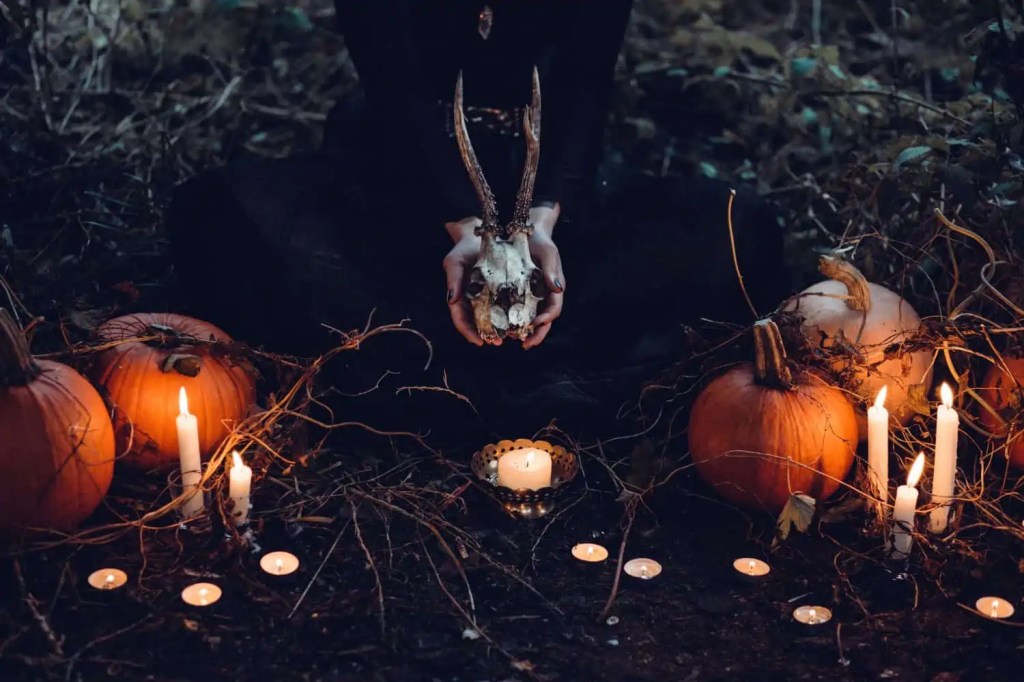
First, let’s talk about what Samhain genuinely was, which was a Gaelic festival that fell on November 1st, with celebrations beginning at sunset on the 31st, because the Celtic day started at dusk, not dawn. It marked the end of the harvest and the start of the “darker half” of the year. It shows up in Old Irish literature as early as the 9th century, most of which was written down by Christian monks working from older oral tradition. What those texts describe is genuinely eerie: Samhain was treated as a liminal time when the boundary between this world and the Otherworld blurred, when the aos sí (the fairy-folk, roughly) were more likely to make contact with the living, and when the souls of the dead were believed to return home looking for hospitality. Their families even set places at the table for them in anticipation of their return. Guising and mumming–going door to door in costume–likely started as a way to blend in with or hide from whatever was wandering that night. So, yes, genuinely a festival about thresholds, the dead, and things crossing over. The bones of “thin veil” are really there.
Now, the historian Ronald Hutton has pushed back hard on the popular claim that Samhain was “the Celtic New Year.” He argues that the evidence for that specific framing is thin (no pun intended) and that it mostly traces back to 19th-century scholars like James Frazer rather than medieval sources. This doesn’t necessarily undercut the festival’s power, though. It’s just a good reminder that “ancient tradition” claims are worth a second look, even the ones scholars themselves have repeated.

Which brings me to the actual surprise: the phrase “the veil” itself. It isn’t Celtic at all. The metaphor traces back to Greco-Roman writers like Plutarch and Proclus describing a statue of Isis in Egypt inscribed with a warning that no mortal had ever lifted her veil–-veil-as-nature’s-secrets, not veil-as-doorway-to-the-dead. That image got picked up and reworked across the 17th through 19th centuries as a stock metaphor for both scientific and occult discovery, and it really took off in 1877 when Helena Blavatsky titled her foundational Theosophy book Isis Unveiled. From there it fed directly into early Wicca. An early draft of the Gardnerian “Charge of the Goddess” was literally titled “Lift Up the Veil.” Somewhere in the 20th-century Wiccan and Neopagan revival, that borrowed Egyptian-via-Theosophy veil got grafted onto Samhain’s very real liminal-time beliefs, and the two merged into the phrase we all use now without a second thought.
I don’t think that makes the phrase less worth saying, though. If anything I like it more now because it’s not a fossil, it’s a living tradition still being built, the same way Samhain itself was never one fixed thing but a belief that different generations kept adding rooms onto.
And once you’re thinking about thresholds and who crosses them, it’s worth giving a nod to psychopomps. This broader folkloric category of “guide who walks the dead across” shows up almost everywhere you look: Anubis in Egypt, Charon and Hermes in Greece, the Valkyries in Norse belief, Azrael in Islamic tradition, the shinigami in Japan, crows and owls and black dogs standing in for the role across dozens of cultures that never spoke to each other. Samhain’s wandering dead needed a guide home too; they just didn’t call her “the veil.”

Sources


